Esthetic Biological Contour (EBC) Concept 2.0
Summary-Implant Emergence Profile Design Source: Esquivel et al., Journal of Esthetic and Restorative Dentistry, 2025/2026 J Esthet Restor Dent - 2026

Why EBC Matters
Dental implants are biologically inferior to natural teeth due to:
Absence of Sharpey’s fibers
Reduced vascularity
Weak epithelial attachment (hemidesmosomes only)
Because implants lack a true periodontal attachment, prosthetic contour directly determines peri-implant tissue health. The EBC concept provides a zone-based framework to design emergence profiles that respect biology while achieving esthetics.
Implant Supracrestal Complex (ISC)
The prosthetic components interact with:
Sulcular epithelium
Junctional epithelium
Supracrestal connective tissue
The abutment/restoration is divided into three biologically distinct zones, each with a specific function, morphology, and material indication.
1. E-Zone (Esthetic Zone)
Location
First 0.5–1.0 mm subgingival
Contacts sulcular epithelium
Primary Function
Esthetic stabilization of the free gingival margin
Morphology
Gentle convexity
Over-contouring increases risk of recession, especially in thin phenotypes
Soft Tissue Requirement
Minimum 3 mm facial soft tissue thickness at implant neck recommended to prevent recession and discoloration
Material
Zirconia preferred for superior esthetics and polishability
Surface Characteristics
Highly polished
Glazing discouraged due to increased roughness and plaque accumulation
Clinical Notes
Tissue displacement (coronal/apical) is possible but limited by tissue volume
This zone is for esthetic conditioning, not biologic sealing
2. B-Zone (Bounding / Barrier Zone)
Location
Apical to E-zone
Coronal to C-zone
Contacts junctional epithelium
Primary Function
Establishment and maintenance of the mucosal seal
Biologic Considerations
Epithelial attachment is weak and easily disrupted
Repeated abutment disconnection leads to epithelial downgrowth and bone remodeling
Morphology (Critical)
Concave profile recommended
Convex profiles are associated with significantly higher recession risk
Concavity increases epithelial barrier length and supports tissue stability
Material
Zirconia or titanium
Zirconia preferred in esthetic zones if space allows
Surface Characteristics
Highly polished
Target surface roughness Ra < 0.2 μm
Glazed zirconia discouraged
Excessive hydrophilicity reduces epithelial adhesion
Clinical Notes
Bleeding on first provisional removal may indicate healthy epithelial attachment disruption, not inflammation
One-abutment-one-time philosophy is preferred
3. C-Zone (Crestal Zone)
Location
From implant platform to B-zone
Contacts supracrestal connective tissue
Primary Function
Long-term crestal bone stability
Morphology
Straight or slightly concave
Slim profile critical
Vertical Design Principles
Abutment flare should begin approximately 2 mm above the bone crest
For subcrestal implants:
Maintain 1.5–2 mm supracrestal connective tissue space
Deeper implant placement requires a longer C-zone
Abutment Height Evidence
Short abutments (≈1 mm) show significantly greater marginal bone loss
Taller abutments (≈3 mm) demonstrate improved bone stability
NOTE: This section is debatable- it all depends on the depth- anything that is near the bone and corresponds to crestal zone ( verify with radiographs) that is the height. Shallow placed implants will make you use shorter abutments and hence bone loss with extreme emergence
Material
Titanium is the material of choice
Allows thin walls
Better mechanical strength
Promotes organized connective tissue and reduced bone remodeling
Ti-Base vs Custom Abutments
Ti-bases acceptable for ideally positioned implants
Custom titanium abutments recommended for:
Deep implant placement
Non-ideal angulation
Limited restorative space
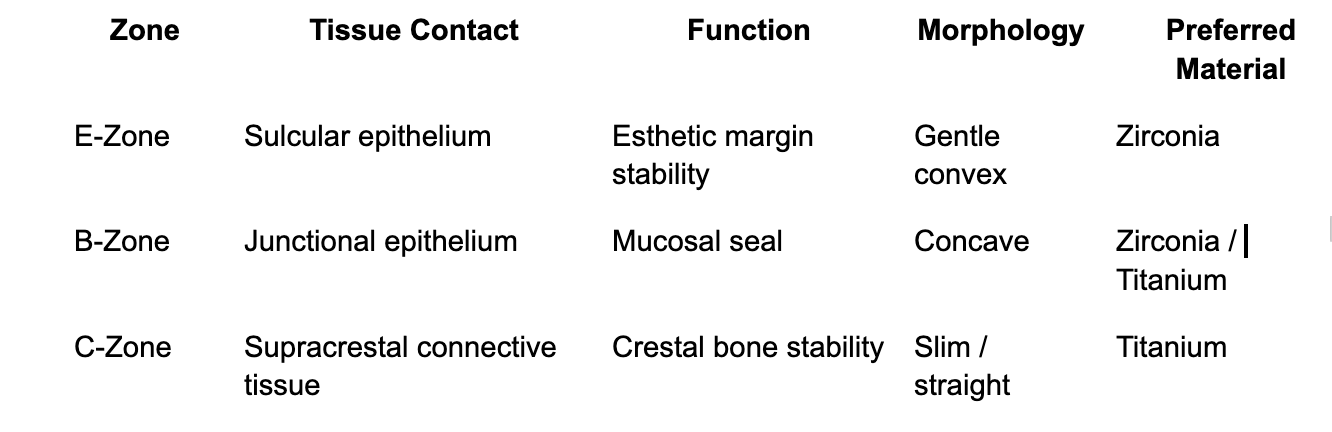
High-Yield Summary Table
Key Takeaways
Emergence profile design is biologically driven, not cosmetic
Concavity in the B-zone is protective
Abutment height and flare position directly affect bone loss
Material selection must respect both biology and mechanics
Most peri-implant complications are prosthetically induced